
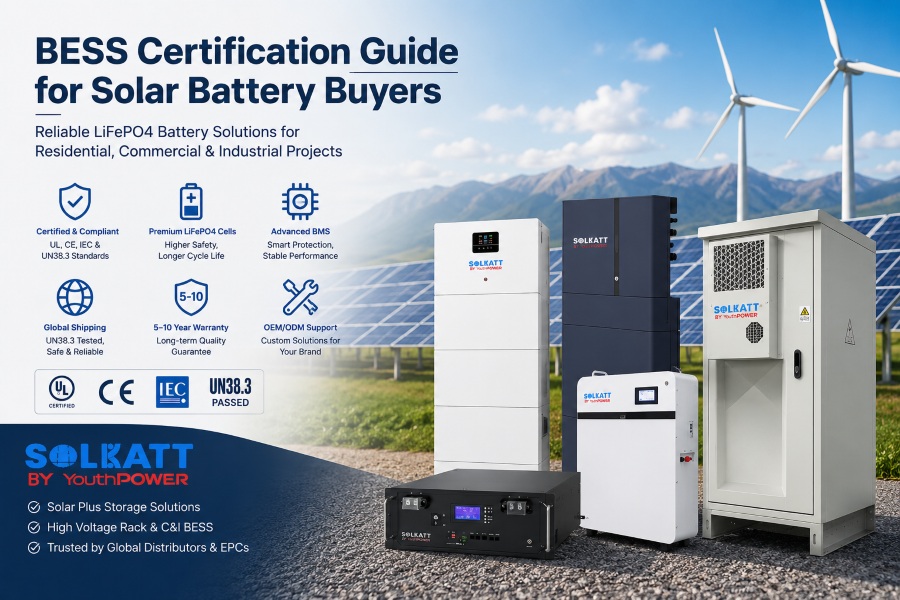
For solar battery wholesalers, installers, battery distributors, and EPC contractors, choosing a reliable BESS supplier involves much more than comparing battery prices. Product safety, cell quality, battery certification, transportation compliance, warranty, technical support, and customization all directly affect project reliability and long-term business value.
As a professional YouthPOWER Solar Battery Manufacturer, we provide LiFePO4-based energy storage solutions for residential, commercial, and industrial applications. Our solutions can also be customized according to project requirements, including high-voltage rack-mounted systems and commercial BESS solutions.
This FAQ guide explains what B2B buyers should evaluate before selecting a solar battery supplier.
What Battery Certification Should a BESS Supplier Provide?
Certification should be one of the first points checked when purchasing batteries for solar plus storage projects.
Depending on the product, target market, and system configuration, buyers may need documentation related to standards such as UL, IEC, CE and UN38.3.
For example, IEC 62619 specifies safety requirements and tests for secondary lithium cells and batteries used in industrial applications, including stationary energy storage systems.
For North American projects, UL 1973 is relevant to stationary batteries, while UL 9540 addresses complete energy storage systems and evaluates areas including charging, discharging, protection, controls and communication.
For European markets, CE compliance involves applicable EU requirements and an EU Declaration of Conformity. The EU Battery Regulation also places documentation, marking and conformity obligations on manufacturers and distributors.
B2B buyers should therefore request the actual certificates, test reports and declarations that apply to the specific battery model—not simply rely on certification logos shown in a product brochure.
What Cell Quality Should You Look for in a LiFePO4 Battery?
The battery cell is the foundation of every LiFePO4 solar battery.
For wholesalers and distributors, important factors include:
√Cell chemistry and grade
√Cell consistency
√Capacity tolerance
√Internal resistance
√Cycle-life performance
√Manufacturing traceability
√Production batch control
√Cell testing procedures
High-quality cells can help improve battery consistency and long-term system reliability. However, cell quality should always be evaluated together with the BMS, thermal management, electrical design and manufacturing process.
For this reason, a professional solar battery wholesale supplier should be able to provide technical specifications and quality-control information rather than focusing only on nominal capacity and price.
How Does a Battery Management System Protect BESS?
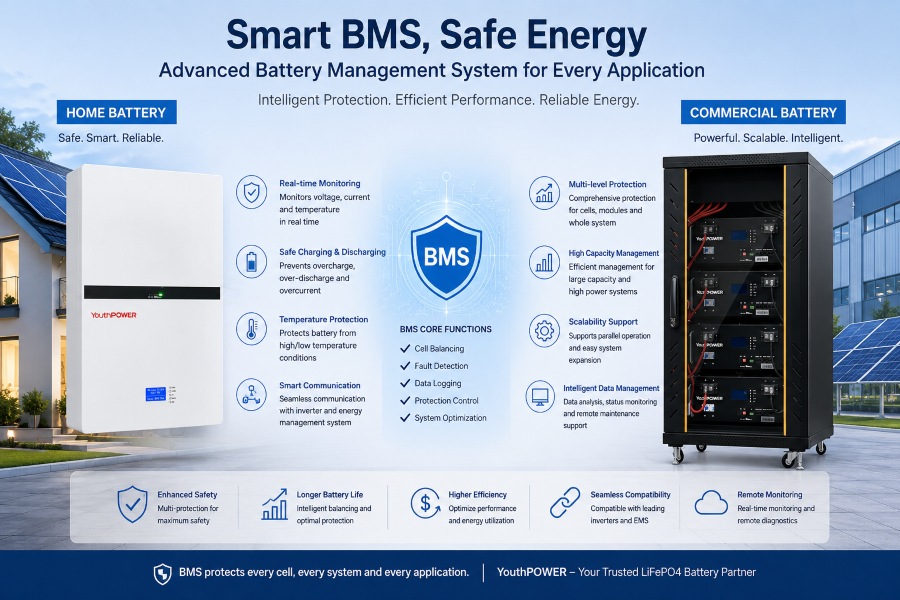
The battery management system (BMS) is a critical part of a modern BESS.
A properly designed BMS monitors parameters such as voltage, current and temperature while helping protect the battery against conditions such as overcharge, over-discharge, overcurrent and abnormal temperatures.
For a home battery, BMS performance supports safe daily charging and discharging. For a commercial battery, the BMS becomes even more important because larger battery systems contain more cells, higher energy capacity and more complex operating conditions.
For B2B buyers, it is therefore important to evaluate not only the battery chemistry but also the BMS architecture, protection functions, communication capability and compatibility with the selected inverter or energy management system.
What Is UN38.3 and Why Is It Important for BESS Shipping?
UN38.3 is particularly important when purchasing batteries internationally.
Lithium cells and batteries offered for transportation must meet the applicable design-test requirements in Section 38.3 of the UN Manual of Tests and Criteria. The testing addresses transportation-related stresses including altitude simulation, thermal testing, vibration, shock, external short circuit, impact/crush, overcharge and forced discharge.
Manufacturers and distributors also need to make the appropriate lithium battery test summary available through the supply chain.
For a BESS wholesale order, buyers should therefore confirm:
♠UN38.3 test status
♠Test summary availability
♠Packaging requirements
♠Shipping documentation
♠Sea or air transportation requirements
♠Battery classification
This can help reduce delays and compliance problems during international logistics.
What Warranty Should a Solar Battery Supplier Offer?
Warranty is an important part of B2B purchasing because battery performance affects the profitability of downstream projects.
Before placing a wholesale order, buyers should clearly understand:
♦Warranty period
♦Cycle or throughput conditions
♦Performance guarantees
♦Warranty exclusions
♦Replacement procedures
♦Remote technical support
♦After-sales response process
A professional battery distributor should also be able to obtain technical assistance from the original manufacturer when troubleshooting or warranty issues arise.
For YouthPOWER, warranty and after-sales support are considered part of the complete energy storage solution rather than an independent product feature.
How Should B2B Buyers Choose a BESS Supplier?
For solar battery wholesale, price should not be the only selection criterion.
A reliable supplier should demonstrate:
Certified products + quality cells + reliable BMS + compliant transportation + clear warranty + responsive after-sales support + OEM/ODM capability.
For residential projects, buyers may focus on home battery safety, compatibility and scalability. For commercial applications, commercial battery capacity, thermal management, system integration and long-term service become increasingly important.
For wholesalers, installers, distributors and EPC contractors, choosing a manufacturer with strong technical capabilities can reduce project risks while creating a more reliable supply chain.
Why Choose YouthPOWER for Solar BESS?
YouthPOWER is a professional Solar Battery Manufacturer specializing in LiFePO4 energy storage technology. We support global partners with residential batteries, high-voltage rack-mounted systems and commercial BESS solutions.
For B2B customers looking for solar battery wholesale, BESS wholesale or customized solar BESS, the right approach is to evaluate the complete solution—from cells and BMS to certification, transportation, warranty and after-sales service.
A reliable BESS is not simply a battery. It is a complete, tested and supportable energy storage solution designed for long-term project performance.
For global B2B customers, OEM/ODM capability can be important when distributors, installers and project contractors need customized battery solutions.
YouthPOWER focuses on LiFePO4 battery technology and can customize energy storage solutions according to project requirements, including high-voltage rack-mounted configurations and commercial and industrial energy storage applications.
Customization may involve system capacity, voltage architecture, enclosure design, communication requirements, inverter compatibility, branding and other project-specific requirements.
This allows solar distributors and EPC contractors to develop solutions that better match local market requirements and different project applications.
FAQs:
1.How Can Solar Battery Wholesalers Evaluate BESS Supplier Quality?
A1: Evaluate certifications, cell quality, BMS performance, manufacturing consistency, warranty, technical support, production capacity, and after-sales service to reduce procurement risks.
2.What Information Should EPC Contractors Provide Before Ordering Customized BESS?
A2: Provide project capacity, voltage, power requirements, installation environment, inverter model, communication protocols, backup needs, and operating conditions for accurate BESS customization.
3. How Can Installers Check LiFePO4 Solar Battery Inverter Compatibility?
A3: Check voltage range, charging current, discharge parameters, communication protocols, BMS interface, and inverter compatibility before installing a LiFePO4 solar battery system.
4. Why Is Production Quality Control Important for Commercial BESS Projects?
A4: Strict quality control ensures consistent cells, reliable BMS performance, safe electrical connections, and stable commercial BESS operation while reducing potential field failures.
5. Can BESS Suppliers Support Different Residential and Commercial Applications?
A5: Yes. Professional suppliers can customize LiFePO4 battery solutions for residential and commercial applications based on capacity, voltage, installation conditions, and scalability requirements.